Court: Penalty Petitions OK for Unpaid Medical Bills
In Save A Lot v. Morales (Workers’ Compensation Appeal Board), the Pennsylvania Commonwealth Court reaffirmed a settled rule. An injured worker may file a penalty petition if an employer does not pay medical bills. This is true even if healthcare providers can use the fee review process.
The March 12, 2026 decision is a memorandum opinion, not published. It has no binding precedential authority. Attorneys and courts may cite it only for persuasive value. However, the court relied heavily on earlier reported cases that clearly outline the law.
The result reflects a consistent line of authority addressing unpaid or late medical bills under the Workers’ Compensation Act. For injured workers and practitioners, the decision reinforces a key distinction. It separates provider remedies from claimant rights under the Act.
Why Did This Case Reach the Commonwealth Court?

What happened in the underlying claim?
The injured worker suffered a work-related injury in August 2021 while working for Save A Lot. The parties later entered into a Compromise and Release Agreement. It resolved wage loss benefits. The employer remained responsible for reasonable and necessary health care expenses related to the injury through May 30, 2022.
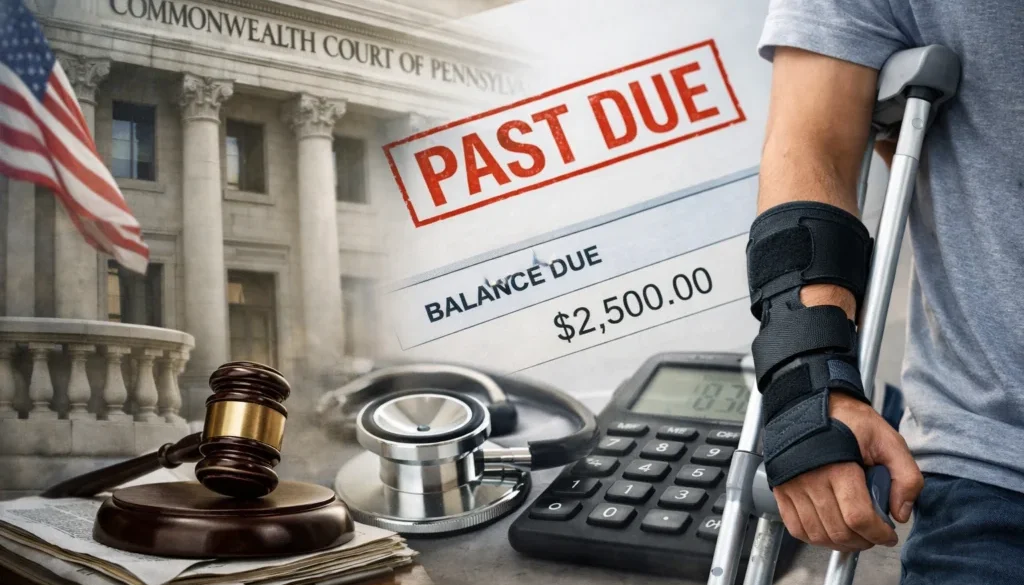
Despite that obligation, some medical costs from a treating physician remained unpaid or paid late. The claimant filed a penalty petition. The claimant alleged the employer violated the Workers’ Compensation Act by not paying those bills.
During the litigation:
- The claimant introduced billing records showing outstanding medical charges.
- The employer presented no evidence contradicting those records.
- The Record suggested the insurance carrier had delayed payment despite requests from defense counsel to resolve the issue.
The Workers’ Compensation Judge ultimately concluded the employer failed to pay or timely pay medical care and imposed penalties.
What Penalties Did the Workers’ Compensation Judge Award?
How did the judge rule on the unpaid medical bills?
The Workers’ Compensation Judge found the evidence showed the physician billed the employer correctly. Some bills remained unpaid. Based on the delay and non-payment, the judge awarded:
- Payment of the outstanding medical invoices
- A 50% penalty on the affected bills
- A 20% of the penalty as attorney fees
- Statutory interest on past-due amounts
The employer appealed the decision to the Workers’ Compensation Appeal Board, which affirmed the judge’s ruling. The employer then sought review by the Commonwealth Court.
What Legal Argument Did the Employer Raise?

Why did the employer claim the judge lacked jurisdiction?
The employer argued that disputes about medical bill amounts or late payments must use the fee review section. The employer argued that a penalty petition could not address these issues.
Under the Workers’ Compensation Act, healthcare providers may request fee review when payment disputes arise. The employer claimed this process served as the exclusive remedy for billing disputes.
According to the employer, the physician did not seek fee review. Because of this, the Workers’ Compensation Judge lacked jurisdiction to address the issue.
What Did the Commonwealth Court Decide?
Did the court agree the dispute had to go through fee review?
No. The Commonwealth Court affirmed the Board and rejected the employer’s argument.
The court emphasized a key point in the Act. The fee review process applies to disputes between providers and insurers. However, it does not limit an injured worker’s right to seek penalties for Act violations.
The court explained:
- Employers must pay reasonable medical expenses related to a work injury.
- Those payments generally must occur within 30 days of receiving a medical bill.
- Failure to comply may support a penalty petition filed by the claimant.
Because the employer paid some medical bills late, the court ruled that the Workers’ Compensation Judge could impose penalties.
Why Did the Court Rely on Earlier Reported Decisions?
What precedent made the result straightforward?
Although this opinion is unreported, the court relied heavily on published Commonwealth Court decisions. These decisions already set the governing principles.
Three cases in particular frame the decision.
Hough v. Workers’ Compensation Appeal Board
In Hough v. WCAB (AC&T Companies), the Commonwealth Court addressed a similar situation involving delayed payment of prescription medication. The court held that the fee review process does not limit a claimant’s right to file a penalty petition. It also does not make that right conditional on late payment of medical bills.
The opinion emphasized that the fee review statute discusses providers and workers compensation insurers, not injured workers. Because of that, it does not restrict the claimant’s separate right to seek penalties for violations of the Act.
This case remains one of the most frequently cited authorities on the issue.
Enterprise Rent-A-Car v. WCAB
The Commonwealth Court also referenced Enterprise Rent-A-Car v. WCAB (Clabaugh).
That decision distinguished between:
- disputes over timeliness of payment, and
- disputes over the amount owed to providers.
Even with that distinction, the court repeated Hough’s main point. The fee-review statute does not limit a claimant’s right to seek Act penalties.
Day-Timers, Inc. v. WCAB
The Commonwealth Court recently revisited the issue again in Day-Timers, Inc. v. WCAB (2025).
In that case, the court again confirmed that:
- employers must pay bills for medical services promptly,
- failure to do so may violate the Act, and
- penalties may apply even when providers possess their own remedies.
The Morales decision relied on this authority to conclude that the Workers’ Compensation Judge had jurisdiction to award penalties.
Does an Injured Worker Need to Prove Financial Harm?
Can penalties apply even if the worker did not pay the bill?
The Commonwealth Court reaffirmed an important principle. A claimant does not need to prove financial harm to receive penalties. Although, attorneys routinely field questions clients have about financial assistance, medical debt, credit reporting, and debt collectors.
Pennsylvania workers’ compensation law protects injured workers from liability for medical treatment related to their work injury. Because employers carry responsibility for those payments, penalties may apply simply to ensure compliance with the Act.
This rule comes from earlier decisions such as Hough and Palmer v. WCAB (City of Phila.).
In other words, the purpose of penalties focuses on enforcing the statute, not compensating the claimant for financial loss.
Why Does the Non-Precedential Status Matter?
What does “unreported” mean in Pennsylvania appellate decisions?
The Commonwealth Court labeled this opinion “not reported.”
Under the court’s internal operating procedures:
- Unreported decisions issued after January 15, 2008
- May be cited for persuasive authority
- But they do not bind future panels of the court or lower courts
Because the Morales decision relies on clear, existing precedent, the court likely issued it as a memorandum. The result largely repeats rules already explained in earlier reported cases.
What Does This Decision Mean for Injured Workers?
How does this ruling affect workers’ compensation claims?
For injured workers, the decision reinforces several practical points:
- First, employers must timely pay medical bills related to a work injury. Delays or denials may violate the Workers’ Compensation Act.
- Second, healthcare providers have their own remedy through the fee review process. But that process does not replace a claimant’s rights.
- Third, injured workers may still file penalty petitions when employers fail to comply with the Act.
- Finally, the Workers’ Compensation Judge retains discretion to determine whether penalties apply and how large those penalties should be.
Final Takeaway
The Commonwealth Court’s decision in Save A Lot v. Morales repeats a clear point. The fee review process does not remove a claimant’s right to seek penalties. This applies when medical bills are unpaid or paid late.
Even though the opinion is unreported, its reasoning follows well-known precedent. It relies in particular on Hough, Enterprise Rent-A-Car, and Day-Timers.
For injured workers, the message remains clear. When employers do not meet their duties under the Workers’ Compensation Act, the law offers ways to enforce compliance. One option is a penalty petition filed with a Workers’ Compensation Judge.