
PA Supreme Court Rules on Notice for Sole Proprietors
What did the Pennsylvania Supreme Court decide in Heater v. WCAB?
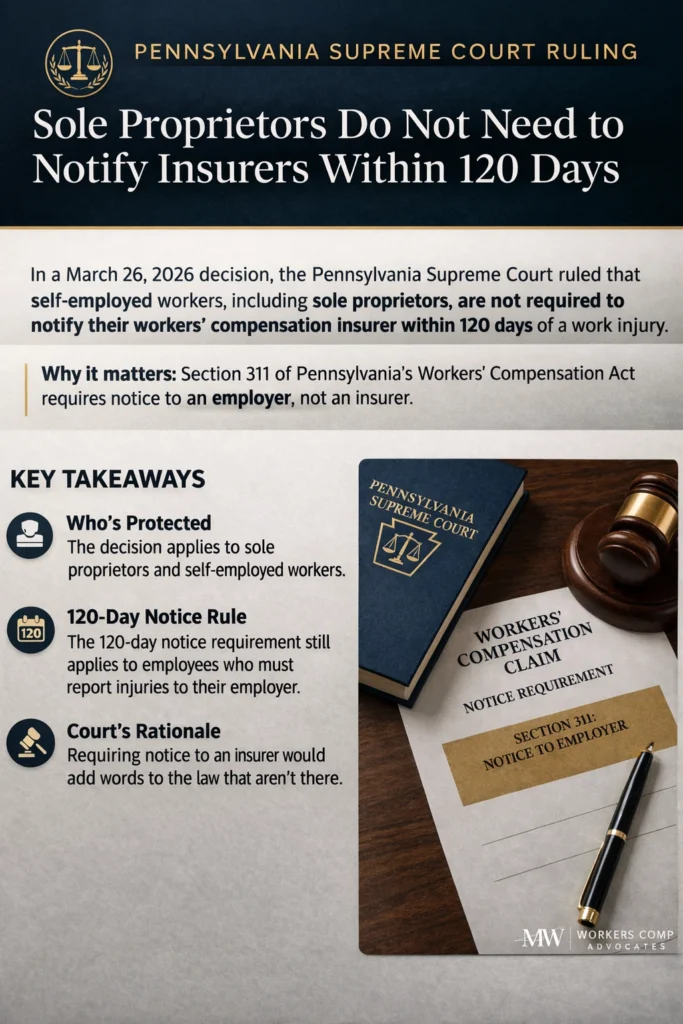
On March 26, 2026, the Pennsylvania Supreme Court issued a major decision. The Court ruled that a sole proprietor with a work injury does not need to notify the insurer within 120 days. This allows the sole proprietor to receive workers’ compensation benefits. The Court also explained that Section 311 only requires notice to an employer, not to an insurer.
This decision reversed the Commonwealth Court and restored the injured worker’s ability to pursue benefits.
Why this decision matters for injured workers
This ruling protects injured workers who operate their own businesses. Many self-employed workers carry workers’ compensation insurance, but they often handle injuries without immediate legal guidance. This decision prevents a technical notice issue from blocking valid claims.
What changed from the lower court decision
The Commonwealth Court had ruled that a sole proprietor must notify the insurance company within 120 days. The Supreme Court rejected that interpretation and returned the case for further proceedings.
What happened in this case?
This case involved a contractor who owned and operated his own business and suffered a serious injury while working.
Key facts of the injury and claim
David Heater worked as both owner and employee of his contracting business. In 2015, he fell from a ladder while doing roofing work. He suffered a severe neck injury and needed surgery.
He later filed a claim for workers’ compensation benefits under his insurance policy.
Dispute over notice
The insurance company argued that it did not receive notice of the injury until well after the 120-day deadline. Based on that claim, it denied benefits.
How the case moved through the system
- A Workers’ Compensation Judge denied the claim based on late notice
- Workers’ Compensation Appeal Board reversed that decision
- Commonwealth Court ruled in favor of the insurer
- Pennsylvania Supreme Court reversed again and sided with the injured worker
Does a sole proprietor need to notify the insurance company within 120 days?
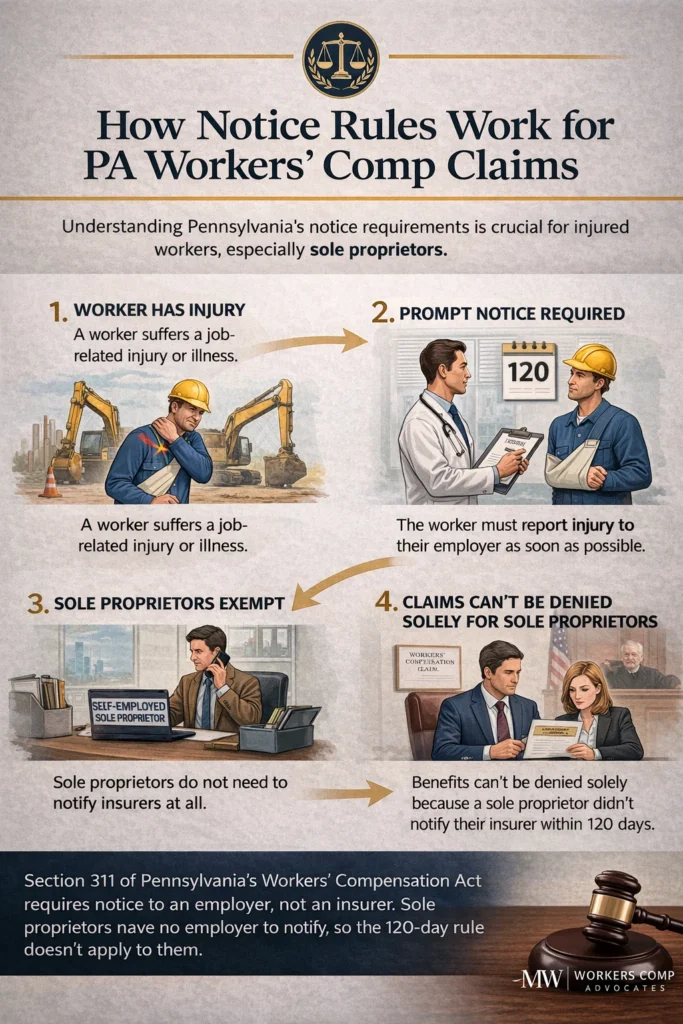
No. The Pennsylvania Supreme Court made clear that Section 311 does not require notice to an insurer. This applies when the injured worker also acts as the employer.
How Section 311 works
Section 311 requires an injured worker to give notice of a work injury to the employer within 120 days. If no one provides notice within that time, the company can deny compensation.
Why the rule works differently for sole proprietors
A sole proprietor stands in the position of both employer and employee. That means the “employer” already has knowledge of the injury at the time it occurs.
No requirement to notify the insurer
The Court refused to add language to the statute that would require notice to an insurance company. The law simply does not include that requirement.
Why did the Supreme Court reject the Commonwealth Court’s reasoning?
The Supreme Court found that the lower court misread the statute and created confusion where none existed.
The dispute over the word “employer”
The Workers’ Compensation Act contains two definitions of “employer.” One definition includes insurers, while the other does not.
Which definition applies
The Supreme Court held that the general definition applies to Section 311. That definition does not include insurers and applies throughout the Act unless a section clearly states otherwise.
Error by the Commonwealth Court
The lower court relied on a broader definition that applies only to procedural sections of the law. The Supreme Court rejected that approach.
Did the Court consider policy concerns about delayed claims?
Yes. The Court acknowledged that insurers raised valid concerns about delayed reporting.
Concern raised by the insurer
The insurer argued that sole proprietors could delay reporting injuries for months or even years. That delay could make investigations harder and limit defenses.
How the Court responded
The Court recognized that concern but explained that courts cannot rewrite statutes to address policy issues. Only the legislature can change the law.
Why statutory language controlled the outcome
The Court focused on the plain language of Section 311. Because the statute remained clear, the Court refused to expand its meaning.
How does this decision affect injured workers in Pennsylvania?
This decision provides important protection for self-employed workers.
Stronger protection for sole proprietors
Sole proprietors no longer face automatic denial of benefits based on failure to notify an insurer within 120 days.
Focus returns to core issues
Claims will now focus on:
- Whether the injury occurred during work
- If medical evidence supports the claim
- Whether disability resulted from the injury
Fewer procedural barriers
The decision removes a technical argument that insurers previously used to deny claims.
Does this ruling apply to all injured workers?
No. This ruling applies only to specific situations involving self-employed individuals.
Who benefits from this decision
- Sole proprietors
- Self-employed individuals with coverage
- Business owners who act as employees
Who must still follow strict notice rules
Traditional employees must still notify their employer within 120 days of a work injury.
What practical steps should injured workers take after a work injury?
Even with this favorable ruling, injured workers should act quickly and carefully.
Report the injury right away
Prompt reporting strengthens a claim and reduces disputes.
Keep detailed records
Maintain records of:
- The date and location of the injury
- Medical treatment
- Communications about the injury
Seek legal guidance early
Workers’ compensation claims often involve complex legal issues. Early guidance can help avoid mistakes.
What should you do if the insurer denied your claim because you gave late notice?
If an insurer denied your claim based on late notice, this decision may help.
Review the reason for denial
Look for language related to failure to notify within 120 days.
Compare your situation to this case
If you operated as a sole proprietor, this ruling may apply.
Act quickly
You may need to file or reopen a claim. Deadlines still apply to filing petitions.
What does this case mean for Pennsylvania workers’ compensation law?
This decision reinforces a key principle in Pennsylvania workers’ compensation law: courts must follow the statute as written.
Plain language governs
Courts will not add requirements that the legislature did not include.
Balance between workers and insurers
The Court acknowledged insurer concerns but placed responsibility on lawmakers to fix any gaps.
Impact on future cases
This ruling will likely guide future disputes involving:
- Self-employed workers
- Notice requirements
- Interpretation of statutory language
Final thoughts on the Heater decision
The Pennsylvania Supreme Court made a clear statement in this case. A sole proprietor hurt at work can still claim benefits. They do not lose benefits just because they did not tell the insurance company within 120 days.
This decision protects injured workers who run their own businesses and removes a major barrier to recovery. At the same time, it highlights the importance of understanding how notice rules apply under Pennsylvania workers’ compensation law.
If you suffered a work injury while self-employed, this case could directly affect your rights.